Thursday, August 30, 2007

Sodom and Gomorrah - Where are they now?


One of the most intriguing stories of the Old Testament is the story of Sodom and Gomorrah - two cities which were so sinful that the bible tells us they were destroyed by "brimstone and fire from the Lord out of heaven" (Genesis 19:24-25) What interests me most about this story is that if such a cataclysmic event actually happened there should be some kind of archaeological evidence to confirm it. Right?

That's what prompted me to begin researching the subject. I've read countless articles on the history of the cities and about a dozen opinions on where they are now. From what I've found there are three differing opinions about the location of these ancient cities:
  • They never existed
  • They are under the Dead Sea
  • They've been found southeast of the Dead Sea
Let's start with the first one. Some people claim that the cities are simply used as illustrations to make little boys and girls be good. You wouldn't want to end up like the cities of Sodom and Gomorrah, now would you? And the truth is, there is no good way to prove that the cities ever actually did exist. However we do have two largely credible sources indicating that the cities did exist and were filled with extreme wickedness: The Bible (Genesis 18-19) and Josephus. Around 194-195 AD Josephus wrote:

Now, about this time the Sodomites, overwhelmingly proud of their numbers and the extent of their wealth, showed themselves insolent to men and impious to the divinity, insomuch that they no more remembered the benefits that they had received from him, hated foreigners and avoided any contact with others. Indignant at this conduct, God accordingly resolved to chastise them for their arrogance, and not only to uproot their city, but to blast their land so completely that it should yield neither plant nor fruit whatsoever from that time forward.

Josephus is largely viewed as a credible Romano-Jewish historian.

Still others insist that the cities are located under the Southern most portions of the Dead Sea. In 1924 an Expedition found five Oases at the southeast corder of the Dad Sea, all made by fresh water streams. Also in the area, on a plain 500 feet above the level of the Dad Sea, they found the remains of a great fortified enclosure, evidently a high place for religious festivals. Just downstream from this site is thought to be the locations of Sodom and Gomorrah. However another quote from Josephus said "The traces or shadows of the ...cities are still to be seen", and the level of the Dead Sea has actually dropped since Josephus' time. So, one could reason, that if Josephus could see the ruins of the cities, we should be able to as well.
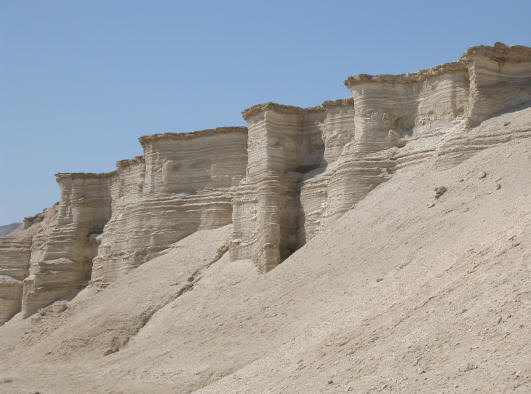
The most interesting theory I found is that the two cities are above ground and easily researched. And I have to admit, they have some pretty convincing evidence.

In areas just to the South/Southwest of the Dead Sea are rock structures which have an amazing resemblance to man made structures. The walls of a city, standalone buildings, even some sort of a sphinx formation which may have been an ancient place of worship. Many of the cuts in the rock are perfect 90 degree angles and symmetrical - which rarely happens in the wild.
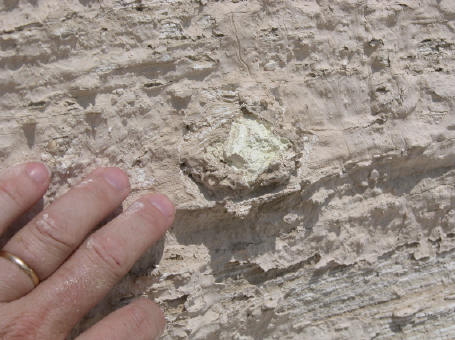
The Bible says "Then the Lord rained brimstone and fire on Sodom and Gomorrah..." and wouldn't you know it, they've found sulfur (brimstone) balls. Lots of them. Some of them are actually embedded in the walls (see right) which would seem to indicate that they were moving at an incredible rate of speed.


And just in case that's not convincing enough they've also found limestone rocks that show signs of being melted, a cache of burned gold, burned bones, burned jars and burned tile. Now that's a lot of burning.

While I doubt we'll ever know for sure, and I won't try to sell my opinion to you, I have to say that option #3 is what I would go with if I were a gambling man, which I'm not. But all of the things I mentioned above do make for a pretty convincing argument that at one time there were cities - and they were burned.

Until next time.

Tuesday, August 28, 2007

The Rosetta Stone


The Rosetta Stone is considered by many to be the key to the Ancient Egyptian Language. It was originally created in 196 BC and then discovered by French Army engineer Captain Pierre-Francois Bouchard in July of 1799. Comparative translation of the stone greatly assisted in understanding many previously unreadable examples of hieroglyphic writing. The text of the Rosetta Stone is a decree from Ptolemy V describing the repealing taxes and instructions to erect statues in temples.

The stone is roughly 114 centimeters high, 72 centimeters wide and 27 centimeters thick (45"X26"X11") and weighs roughly 1,676 pounds.

Soon after it's discovery Napolean returned to France and 167 scholars remained with the French troops. In 1801 the British Army landed on Aboukir Bay and the scholars carried the stone from Cairo to Alexandria with the Troops of de Menou. However, a short short time the French army surrendered. This caused a large dispute over the fate of the French archaeological and scientific discoveries of Egypt. De Menou claimed that the discoveries belonged to the institute and refused to hand them over. British General John Hely-Hutchinson claimed all archaeological materials as a property of the British Crown, but de Menou regarded the stone as his private property and hid it.

It is unknown exactly how the stone came into possession of the British. But on March 11, 1802 Tomkyns Hilgrove Turner brought the stone onto a captured French vessel and brought it back to England.

The text on the Rosetta Stone is written with the same text in two Egyptian languages: hieroglyphics/demotic and in classic Greek. It was fully translated in 1824 by Jean-Francois Champollion. Champollion was fluent in both Greek and Coptic and figured out what the seven Domotic signs in Coptic were. By looking at the signs in Coptic he was able to work out what they meant in the hieroglyphic signs. Finally, in 1858 the Philomathean Society of the University of Pennsylvania published the first complete English translation. The translation reads as follows:

In the reign of the new king who was Lord of the diadems, great in glory, the stabilizer of Egypt, and also pious in matters relating to the gods, superior to his adversaries, rectifier of the life of men, Lord of the thirty-year periods like Hephaestus the Great, King like the Sun, the Great King of the Upper and Lower Lands, offspring of the Parent-loving Gods, whom Hephaestus has approved, to whom the Sun has given victory, living image of Zeus, Son of the Sun, Ptolemy the ever-living, beloved by Ptah;
In the ninth year, when Aëtus, son of Aëtus, was priest of Alexander and of the Savior Gods and the Brother Gods and the Benefactor Gods and the Parent-loving Gods and the God Manifest and Gracious; Pyrrha, the daughter of Philinius, being athlophorus for Bernice Euergetis; Areia, the daughter of Diogenes, being canephorus for Arsinoë Philadelphus; Irene, the daughter of Ptolemy, being priestess of Arsinoë Philopator: on the fourth of the month Xanicus, or according to the Egyptians the eighteenth of Mecheir.

THE DECREE: The high priests and prophets, and those who enter the inner shrine in order to robe the gods, and those who wear the hawk's wing, and the sacred scribes, and all the other priests who have assembled at Memphis before the king, from the various temples throughout the country, for the feast of his receiving the kingdom, even that of Ptolemy the ever-living, beloved by Ptah, the God Manifest and Gracious, which he received from his Father, being assembled in the temple in Memphis this day, declared:

Since King Ptolemy, the ever-living, beloved by Ptah, the God Manifest and Gracious, the son of King Ptolemy and Queen Arsinoë, the Parent-loving Gods, has done many benefactions to the temples and to those who dwell in them, and also to all those subject to his rule, being from the beginning a god born of a god and a goddess—like Horus, the son of Isis and Osirus, who came to the help of his Father Osirus; being benevolently disposed toward the gods, has concentrated to the temples revenues both of silver and of grain, and has generously undergone many expenses in order to lead Egypt to prosperity and to establish the temples... the gods have rewarded him with health, victory, power, and all other good things, his sovereignty to continue to him and his children forever.


For more information, please purchase a Biblical Dictionary listed along the left side of this page.